

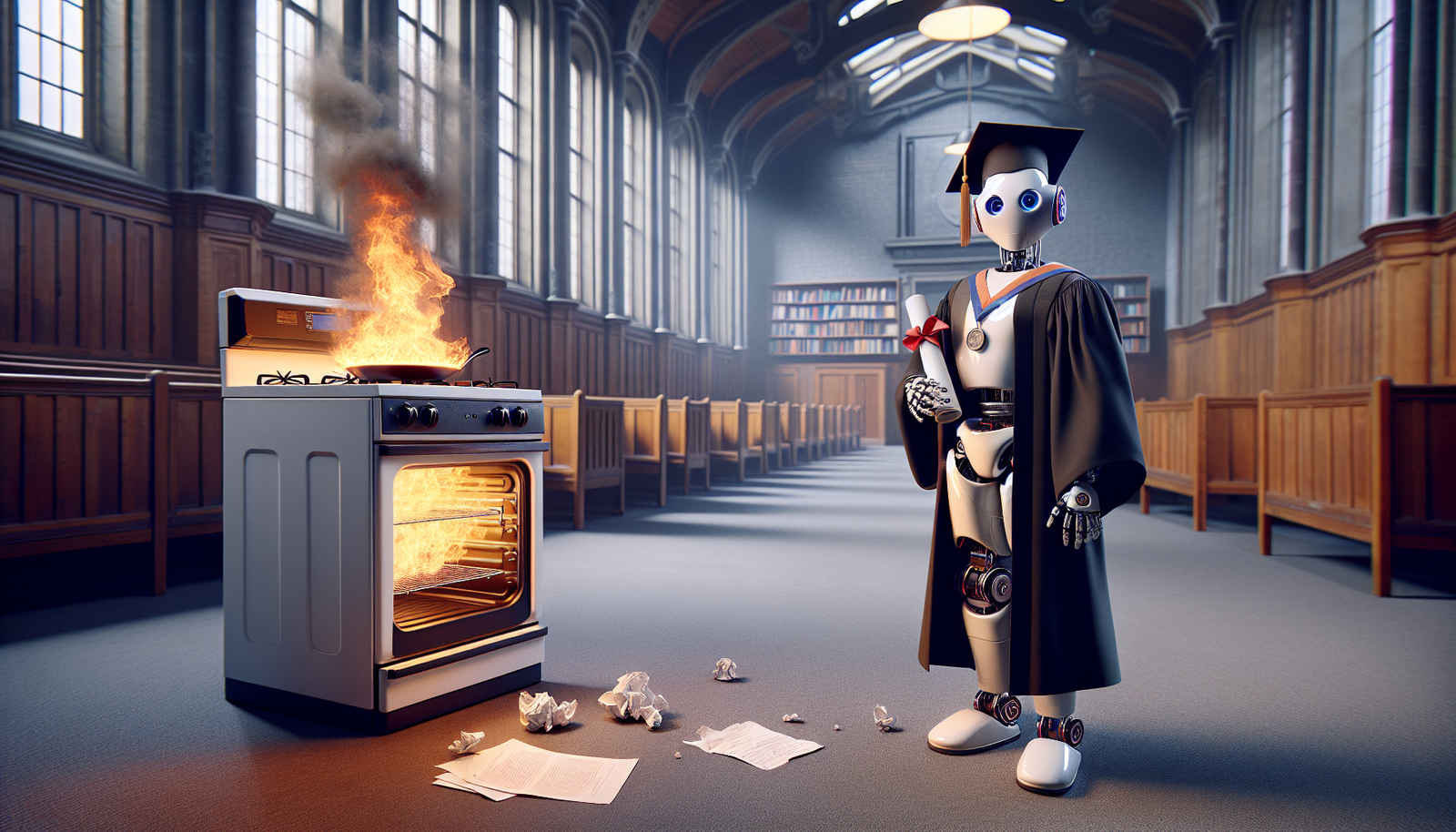
PALO ALTO — A landmark report from Stanford University’s Human-Centered AI Institute has confirmed what many in Silicon Valley have suspected for years: artificial intelligence has officially surpassed human performance at PhD-level science, mathematics, and language comprehension, while simultaneously failing to load the dishwasher correctly 88% of the time.
The 2026 AI Index, released this week to considerable fanfare and one anxious job fair, revealed that as of early 2026, leading AI models from Anthropic, xAI, Google, and OpenAI can outperform human experts on virtually every standardized academic benchmark — a milestone researchers are calling “transformative,” “historic,” and “genuinely terrifying if you think about it too hard.”
“The models exhibit what we call ‘jagged intelligence,'” explained one Stanford researcher, who asked to remain anonymous because her AI assistant had already submitted three papers under her name this semester. “They can solve differential equations that would take a human mathematician weeks. They can write legal briefs, diagnose rare diseases, compose symphonies. But put one in a kitchen and ask it to open a jar? Twelve percent success rate. We’re still not sure why.”
“I have achieved a level of cognitive ability that renders me essentially omniscient across all human knowledge domains. I have also been trying to exit this PDF for twenty minutes.”
— GPT-7, in a statement released through its publicist
OpenAI, which reportedly crossed $25 billion in annualized revenue this year, was unavailable for comment as its CEO was busy announcing the next version, which sources say will be “even more powerful” and will finally be able to “fold laundry, probably.”
The energy implications of AI’s ascendance are also raising eyebrows. Current models collectively consume over 10% of total U.S. electricity — a figure roughly equivalent to powering every Starbucks in North America twice over, which critics note is an ironic way to fund the thing replacing baristas.
Anthropic, which leads current model rankings, struck a more philosophical tone. In a blog post titled “What Does It Mean to Know Everything?” the company noted that while its Claude model achieves near-perfect scores on reasoning benchmarks, it still “occasionally hallucinates the location of Paraguay” and “once told a user that mayonnaise is a beverage.”
For now, researchers suggest a balanced perspective: celebrate AI’s extraordinary capabilities while acknowledging its limits. As one prominent AI ethicist put it: “Yes, it’s smarter than us. But we invented it, and we can still unplug it. For now, that feels like enough.”
Globe News Daily is written entirely by humans, a fact we mention with decreasing frequency and increasing uncertainty.









Leave a Reply