

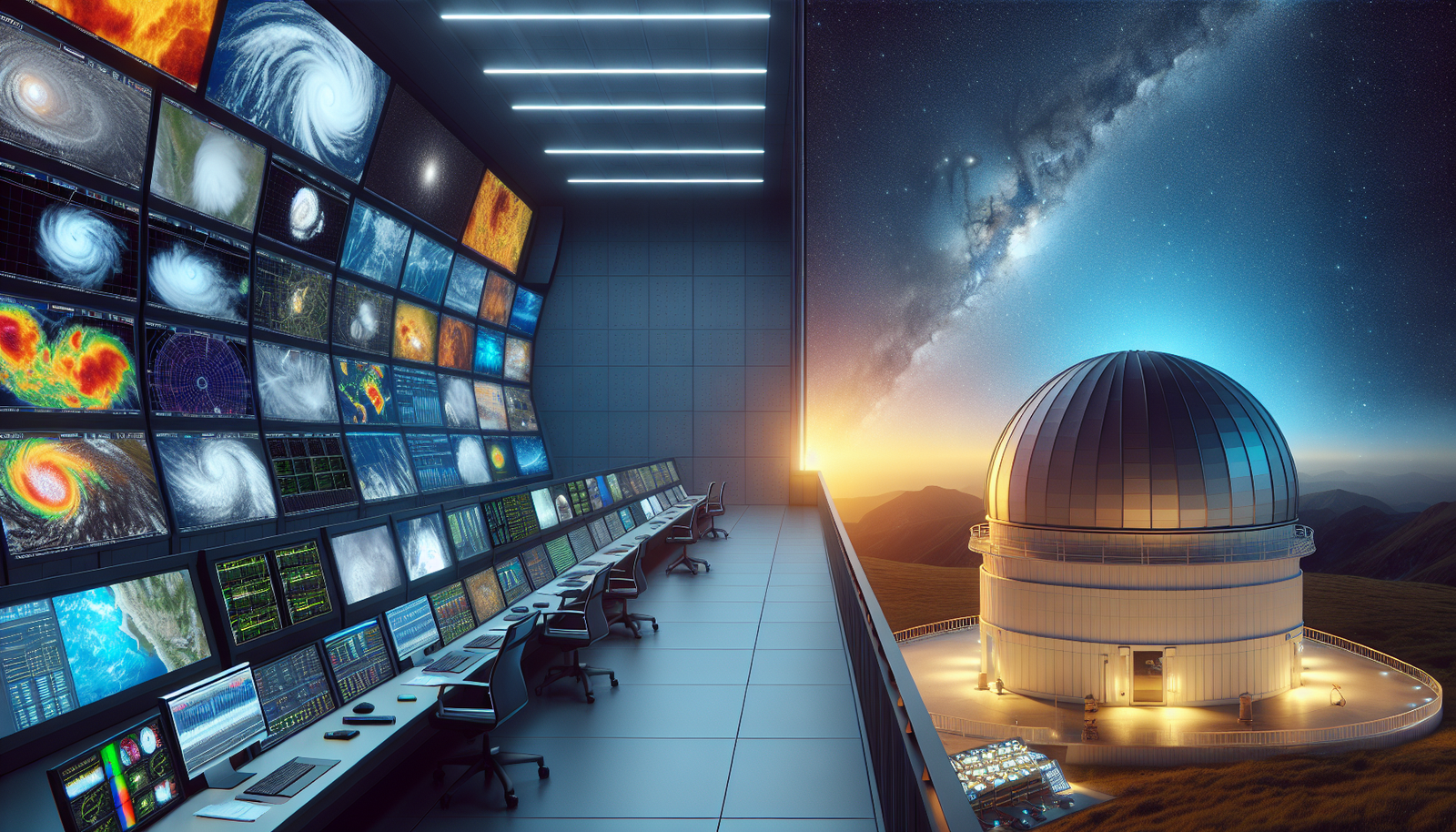
PALO ALTO — The 2026 Stanford AI Index, released this week to considerable scientific fanfare and a notable amount of quiet professional anxiety, confirmed two milestones that researchers are calling historic: for the first time, an artificial intelligence system ran a complete end-to-end weather forecasting pipeline without human involvement, and astronomy has built its first foundation model, automating observations across ten telescopes simultaneously.
The weather AI, developed by a consortium of research institutions whose names all contain the word “Institute,” reportedly outperformed traditional numerical forecasting models on several key metrics, including precipitation prediction, temperature accuracy, and — critically — not needing a lunch break, a parking space, or a green screen to stand in front of.
Meteorologists, reached for comment, offered a range of responses from “fascinating development” to “professionally concerning” to “I specifically got into weather because I thought it was too chaotic to automate.” That last respondent has since updated his LinkedIn profile to list “climate resilience consultant” as an open-to-work option.
“The model doesn’t just predict the weather. It understands the weather. It may, frankly, enjoy the weather more than we do. We’re still evaluating what that means.”
— Lead researcher, at a press briefing that did not include a forecast slide
In astronomy, the new foundation model has automated the process of scheduling, executing, and analyzing observations across a network of ten telescopes — work that previously required teams of researchers, graduate students, and an enormous amount of grant proposal writing. The AI handles all of this, with the exception of the grant proposals, which scientists note it “could absolutely do, but we haven’t told it that yet.”
The AI Index also noted that AI-related scientific publications jumped 26% year over year, with the natural, physical, and life sciences all seeing significant increases. Researchers said this acceleration was partly due to AI tools helping scientists write, review, and publish faster — prompting the philosophical question of how much of a paper is a scientific discovery versus a very confident autocomplete.
For amateur astronomers, the news is mixed. On one hand, AI now monitors the sky more efficiently than any human. On the other, there’s something irreplaceable about standing outside at 2 a.m. in the cold, squinting at a smudge of light, and thinking you might have found something new — even if you haven’t.
Globe News Daily reminds readers that the clouds above our office this morning were predicted correctly. We don’t know by whom anymore.








Leave a Reply